On July 7, the Trump Administration issued a new Executive Order targeting renewable energy sources, just a few days after the OBBB removed many of the subsidies originally passed in the IRA.
For too long, the Federal Government has forced American taxpayers to subsidize expensive and unreliable energy sources like wind and solar. The proliferation of these projects displaces affordable, reliable, dispatchable domestic energy sources, compromises our electric grid, and denigrates the beauty of our Nation’s natural landscape.
In the months leading up to the OBBB, many pointed out that the U.S. has long subsidized the fossil-fuel and nuclear industries.
On LinkedIn, Rory Huntley put together this helpful chart showing that the federal government has provided incentives to the oil and gas industry for over 100 years.
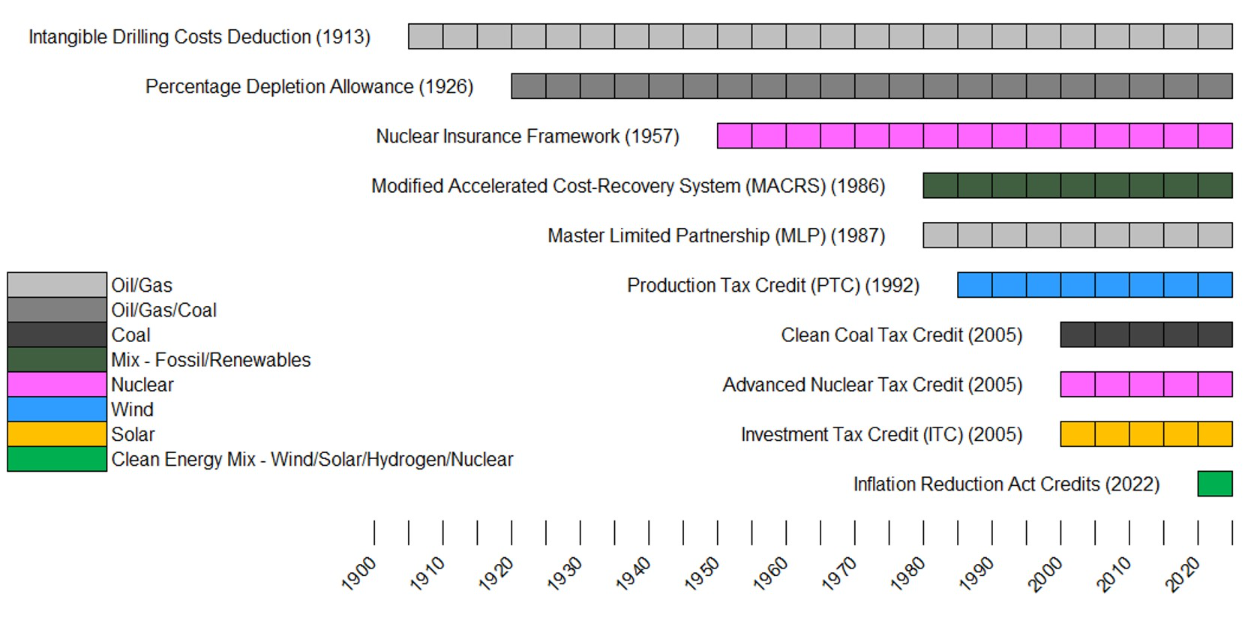
I was curious how oil and gas companies talked about these incentives and found a 1973 Congressional hearing about the Intangible Drilling Costs (IDC) deduction and Percentage Depletion Allowance.
Here are a few statements from Robert Dunlop, CEO of Sun Oil Co. (Emphasis added by me.)
From the beginning of the Federal income tax system, incentives have been provided to encourage development of our country’s oil and gas resources. And with those incentives, the domestic industry has provided the American people with abundant, secure supplies of oil and gas at very reasonable cost.
An unacceptable level of dependence on imported oil can be avoided only by providing economic incentives sufficient to encourage the commitment of the huge amounts of capital necessary to develop additional domestic producing capacity.
The energy job cannot be done without new capital investment on an unprecedented scale. And proven incentives such as percentage depletion and the IDC deduction have demonstrated their ability to attract capital and spur the desired activity without resulting in above-average profits for the oil industry.